Recently in pottery Category

translations

| 1 Comment | No TrackBacks
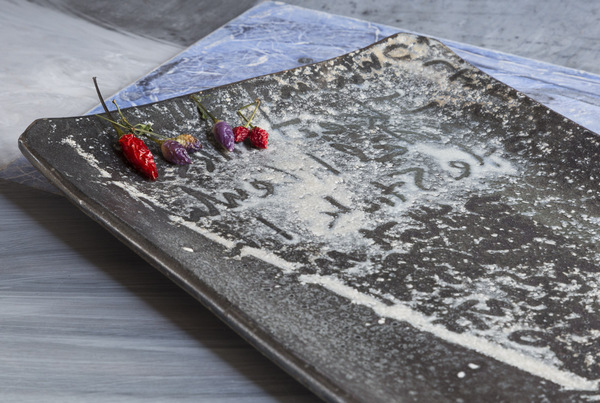
 WS-White-Sky-plates.jpgA Romanian poet  tells a joke about a tourist who asks two policemen in English for directions to the art museum. One policeman shrugs uncomprehending so the tourist asks in French " Ou est les Musee des arts?" Again the officer shrugs, undaunted the tourist asks again in German "Wo ist dei kunsthalle?"  Again he shrugs like he doesn't understand. Frustrated the tourist walks away and one officer says to the other ... "That guy sure knew a lot of languages" and the other one responds "Yeah a lot of good that did him."

WS-red-horizon-plates.jpgAs I worked at Watershed center for the arts I found myself thinking about the joke as a poetic parable for my work in Maine. I jumped in working with brick clay at a low temperature unsure if the conversion from my known clay and high temperature would work. I translated the materials in my clay and slip to the lower temperature of the brick clay and short nature of an open material.

WS-brushgrain-cocoon.jpg Like the tourist in the joke I kept barreling ahead trying different versions of the same idea.

WS-open-cocoon.jpgI was after the appropriate paraphrasing between hand, material and firing temperature. The language of unglazed wood fired work imposed itself on my explorations in the iron rich clay.

WS-septet.jpgI loved the opportunity to be totally immersed--one of the younger potters commented that the more mature potters were kind of intense and I said its just such a gift of time and space and lack of other responsibility to work.

WS-quintet.jpgWe also understood the variety of forms required to fill a kiln and the time restraints of drying and firing with in two weeks.

makemakemake.jpgLike the graffiti in the bathroom at the factory which said "make make make" backwards and forwards I inhaled the spell of the words.

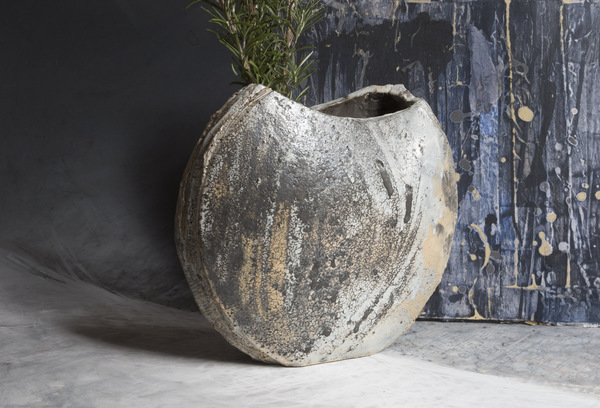
WS-flat-moon-vase.jpgI wasn't trying to render exact forms but translate the impetus to make forms. There wasn't time to refine the deeper kind of visionary intuition but there was a mystery in the clumsiness and awkwardness and make due kind of approach of a new environment. Its adds a dimension of spice to the work. These pots have a kind of betwixt and between approach.

WS-small-moon-vase.jpg Part of the pain of not having the right tool for the job is also part of the mad scientist creativity that is beautiful. I cant help but look at the pots I made and think what if I had the gift of another two weeks. What would the next step be. What would I make on the next round?

WS-graduated-bowls.jpg

watershed 2010

| No Comments | No TrackBacks
factory.jpgI imagined that I would post as we worked for two weeks here at watershed center for the ceramic arts. However we were so immersed in the clay and people that I didn't have time to look at my photos or digest the experience.I loved the feeling of being in Maine and working in the old building with out my normal habits and tools. it was disorienting and exhilarating.

clay-pile.jpg
The first step was to mix the local brick clay.

clay-scoop.jpg
Make pots, and discover the nature of the material.

cup.jpg 
I have experimented with new clay, low temp soda atmosphere and I loved rubbing shoulders with the other artists.


soda-kiln.jpg


eggs

| 2 Comments | No TrackBacks
egg-line.jpg

On Wednesdays my yoga group practices in a church parish house in Delaplane, Virginia.We trade off leading the practice and at the end Tom lead us in a few moments of meditation. I sat on my yoga block with legs folded and back pulled up straight, my arms hollowed like I held fragile eggshells in my arm pits. I lay my left hand inside my right and touched thumbs together making an oval shape. The oval image came back to me again and again. My breathing became a graceful strong egg filling my lungs with silence. Shivasina near the end of our hour is my favorite moment of relaxation. The silence and letting go of every muscle allows space for new images. The moments allow my brain to tumble and not think and I bring my mind back to the oval egg shape of hands, armpits and breath. In the space of shape solutions appear, there is no narrative or evolution. It is like all of a sudden I can see how the jigsaw puzzle pieces fit together magically.


eggs-in-bowl.jpg

I have started making a few pieces for the wood firing in the fall. The ovals of ideas move with my breath. It has been a week to follow intuition and draw on paper and clay. I start where I left off and trust the the next step will come. I moved my chair to the basement gallery space for cool air and the company of the last series of work. I stare at the sunlight and images of eggs that I photographed in March come to mind.They are nestled in gas fired bowls and the pale variation of colors circle in my mind.It is like each cycle of firing is an egg shaped Russian doll. One experience is held in the shape of the next idea, each step grows and shifts.


egg-solo.jpg

Yoga is learning to associate with the seer who resides beyond the language of the mind. ~ PantanjaliI

brushes

| No Comments | No TrackBacks
On a recent trip to Rhode Island brushes caught my eye. 

brushes-antique.jpgThen, visiting David Harrington in Bristol, he took me to see his studio in a nearby old mill building.

brushes-tools.jpgDavid and his studio mate had a beautiful collection of brushes and tools.

brushes-bristol.jpgWhen I got home I looked at my own homemade brushes with a fresh eye.

brushes-cw-1.jpgI started making brushes in college. At first I just loved how they looked. I made all of these but the one furthest to the left which I bought on Canal Street (NYC) in 1979 from a street vendor who said he bought it in Afghanistan. The longer I had them around the more committed I became to using them, to finding the voice of collaboration between each brush, a material, and my hand. They are made of my hair, grasses, feathers and animal fur with bamboo for the handle--at least until that binder clip comes in handy.

brushes-cw-2.jpg"I don't have to lay on the couch and see a therapist because my therapist is in my paint brushes."
Abbey Lincoln

13a-spiral-bowls.jpgCatherine White Slip Decoration Workshop at Hood College
July 17-18, 9 a.m.-5 p.m.
July 17, 6-9 p.m.

The weekend course is an exploration in the vocabulary of  slips applied to clay forms.  The class will be both demonstration and hands-on work.  Saturday and Sunday sessions will be amplified with an evening slide talk of personal work and historical references. Assignments will explore the poetic potential of texture, line, pattern and color variations. The class will weave together the implications of brushwork, additive and subtractive applications, and the interaction of  form, glaze and fire. Assignments will cover experiments with varied techniques.

Bring leather hard plates, bowls and vases plus clay to roll out slabs to experiment on.


ARTS 599 Slip Decoration
July 17-18, 9 a.m.-5 p.m.
July 17, 6-9 p.m.
Instructor: Catherine White

Hood College Frederick Maryland

http://www.hood.edu/academics/departments.cfm?pid=departments_ceramicsWorkshops.html

Workshop Fee : $185
1 credit/Graduate Tuition:$360
to register call Karen Taylor at 
301-696-3526

09-winter-triplet-bottles.jpg


first tomatoes

| No Comments | No TrackBacks
June 29th the first tomatoes were a great treat with lunch.

first-tomatoes-2010.jpg


A year ago now I was just finishing up the wet work phase for the wood kiln. We had an afternoon thunderstorm so I quit to go to the house and watch the rain and clouds blow through. I drew a group of bottles on a window sill to focus my attention on the next batch of small vases for the back of the kiln some of which are pictured below.
 
This morning I have finished making things for the glaze kiln and after a session of weeding and picking flowers, Zoe returned from a run and headed to the pond. With the dog in tow I grabbed my towel and followed her inspiration. The pond was refreshingly cool and floating with eyes at water level I looked at the trees and sky like a water particle or a thought slipping from past to present swims, stroking on to future possible swims.

10-bottles.jpg"Maybe it is simply because the body is about 70 percent water, but swimming in a river confers a sense of intimacy with the natural world that isn't easy to come by. And if you feel you own a little piece of this river, there is also something in the way the real estate of the water slips through your hands that persuades you that the river owns a bit of you as well. It is a fluid exchange. Intimacy with the river, like other kinds of intimacy, is laced with ambiguity, with questions of ownership elusive and variable. And it becomes an easy thing to imagine yourself a particle in the river's continuity, so easy, in fact, that you begin to see things the way the river might see them. And you see, then, how that continuity can be reassuring. You somehow go through life to a certain point always thinking that even if you can't exactly start over, at least you can fix things or change them and that all the missteps and wrong directions can be corrected and that it is never too late. Later you may find yourself believing that is no longer true. I looked up the river and down it. Its flow was certain, its direction unchangeable, but still it could take on the day's nuances of light, the vagaries of the shifting tide." Just Beneath the Surface, Akiko Busch
In 1982 when I first brought pots to the restaurant Omen as examples Mikio, the owner, had said to me, "I need large plates and bowls." I said, "Great, I love to make platters and big bowls."  I brought things Mikio thought looked like bathtubs. I have learned that large is a relative term and in Japanese cuisine there is room for many tiny dishes. A large plate is 8-10 inches. Earlier in the year we sent pots for a photo shoot for a cookbook that Elizabeth Andoh is writing.  I searched my shelves for small interesting things for plating her recipes. The challenge sparked my interest in the beauty of small contours--the interaction of food and small pot.

9-peas.jpg"Craft is about the transformation of substance; it is about the possibility
of one thing becoming another and about accepting ambiguity. And if uncertainty is a liability in the age of information, in the world of craft, it is a material reality, an opportunity, a chance." --Akiko Busch, The Ecology of Uncertainty

white

| 4 Comments | No TrackBacks
White clay seems like the appropriate palette for this time of year especially the winter of 2010. We had over 24 inches of snow last weekend and we are getting more as I type.

bone cup_2222.jpgI often think of winter as being barren, the landscape stripped to the essential bones of structure, but with the recent snows the simplicity I find inspiring is the minimalism that happens through blanketing and softening.

snow horizon_2244.jpgI am always drawn to views composed only of hill and sky. When storms pull in and views are reduced to a limited palette of gray and white it reminds me of slip and clay.

horizon plates raw_2229.jpgThere are moments when the landscape seems flattened like a drawing and then pops into more intricate and sculptural 3-dimensional forms.

slab-pot landscape raw_2249.jpgslab-pot landscape raw_2250.jpgThe drifting snow has allowed my imagination to make new connections  and translations from the summer palette of stoneware and the woodfired kiln to porcelain in the gas fired kiln.

text plates woodfired_2253.jpg
text plate porcelain bisque_2232.jpg

Today is the shortest day of the year. The sun sets early and I'm posting this message before the light merges with night. I have numbered the short days with captured images to share new stories of the year.

21-monkey-balls-2.jpg"As black days came unnumbered, merging with night, the pulaar--visits between villagers---started up again. They told new stories about animal and human doings, about the demise of their traditional lifeways and melting ice caps, and waited in their cold heaven, for the coming of light."
--Gretel Ehrlich, This Cold Heaven, p. 356.