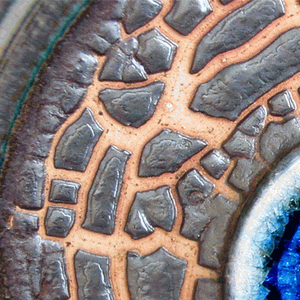
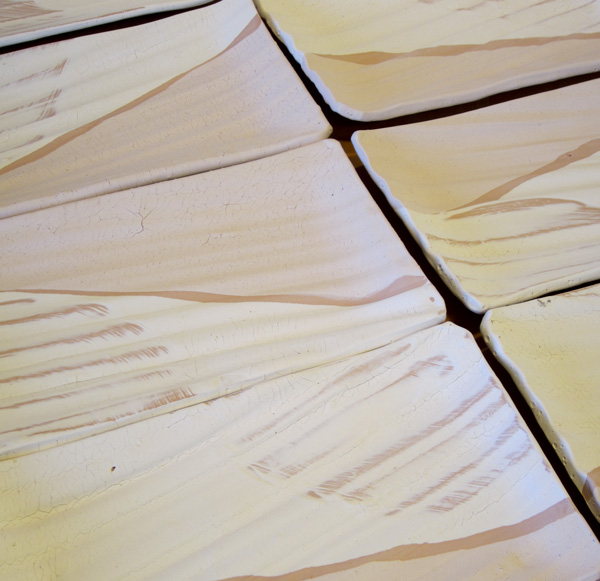
 I am glazing pots for the gas kiln. I told a friend I would send some process images. So as the day progressed I snapped some pix. I clicked the shutter and was reminded that one of the skills a potter has is to see into the future. Beginning with a wet mud-like substance, I understand the nature of drying and shrinkage. I can look at the pink of bisque and imagine what the stoneware clay will look like under a high fired celadon glaze. I look at current experiments with incremental additions of iron in the slip and imagine subtle shifts in the creaminess once fired. As I look through my lens with the eye of a non-potter I wondered how they see the transformation and information that a potter takes for granted.
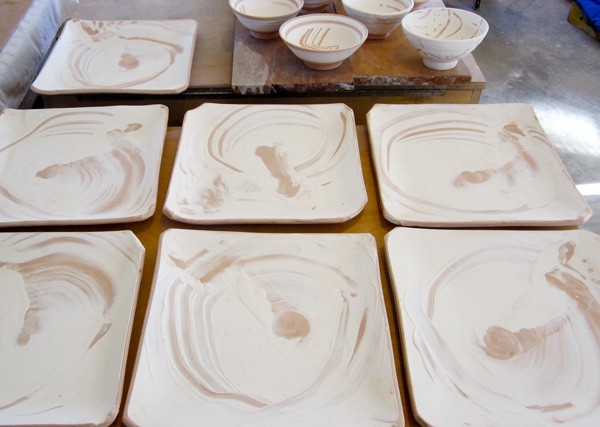 I look at the plates and visualize impending transformations. These plates will make up sets that are a family of close siblings. I work intuitively taking photos and notes as I focus upon the next group of experiments, stretching my capacity to see the unseen. My dual-edged imagination remembers the raw colors and layers I originally fell in love with and lives for the excitement of fire induced transformations into durable, aesthetically usable poem.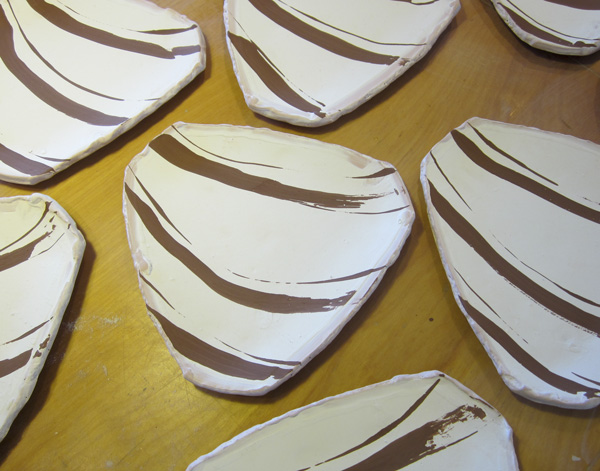
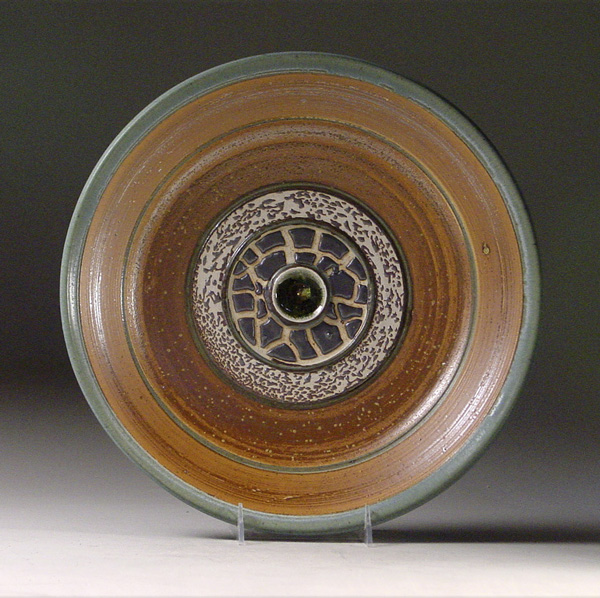 Tuesday I attended a panel discussion at Georgetown University about art and science marking the opening of
 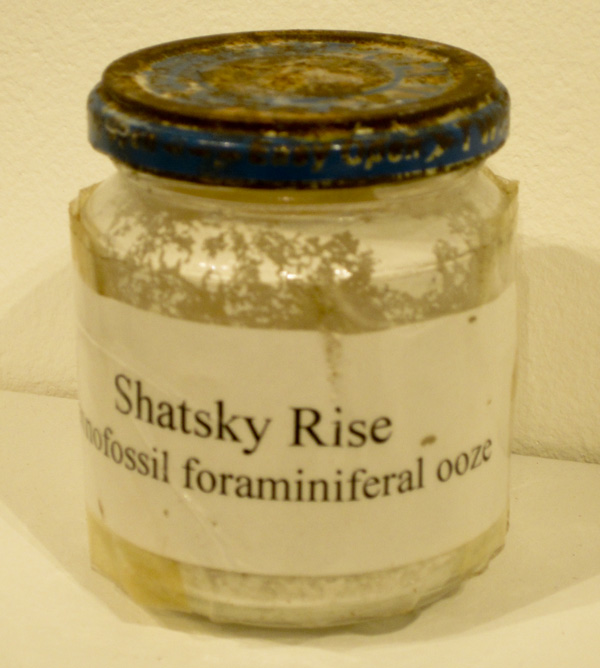 Joan discussed the coincidence of material coming to her door due to the generosity of a coastguard seaman and her proximity to the Woods Hole Oceanographic Institution, which has led to some unusual collaboration. The various forms of mud and ooze flowing across her doorstep have given her a material understanding on a molecular level and a global level due to mapping the origin-locations of her mud. She has had to wrap her imagination around geological history in a daily development of mind and memory. She perseveres in her studio experiments, working with the serendipity of what scientists contribute as well as an acceptance of what the kiln permits as she builds upon trial and error. Embedded in her objects is material knowledge and an artistic endeavor to document location, constructing a confluence of form, surface and variety.
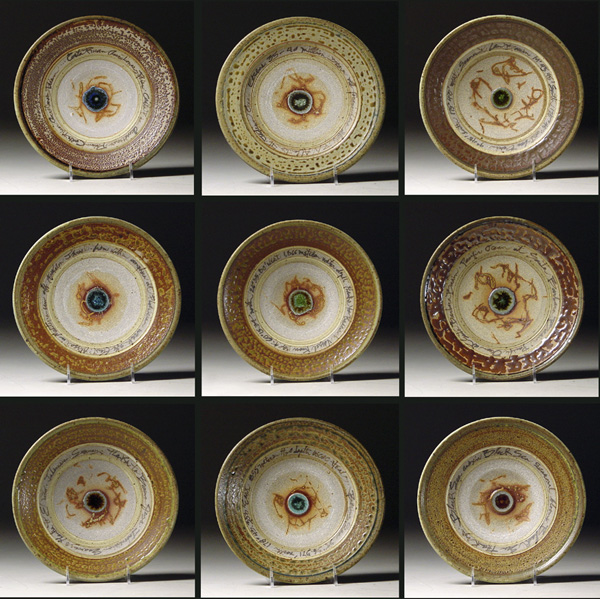 It is when Joan steps outside the usual constructs of pottery craftsmanship, crossing the conventional line with materials that almost melt, that crawl or halo, overall creating poetic variations in surface texture, that they are the most interesting to my eye. Her documentation of heat work and place of origin show the work at its best. The fact that the melted materials are placed on a bowl or a cup or a vase seems almost incidental. There is room for more concept and collaboration of form and surface with the clay. The science has had so much to say there remains more untapped potential for the artistic side to come up to the podium and speak.